



Words have kept me in employment (and fed) for more than half a century and I am indebted to them.
Frequently, I will come across a phrase or idiom where the meaning is well known to me, but its origins are more of a mystery.
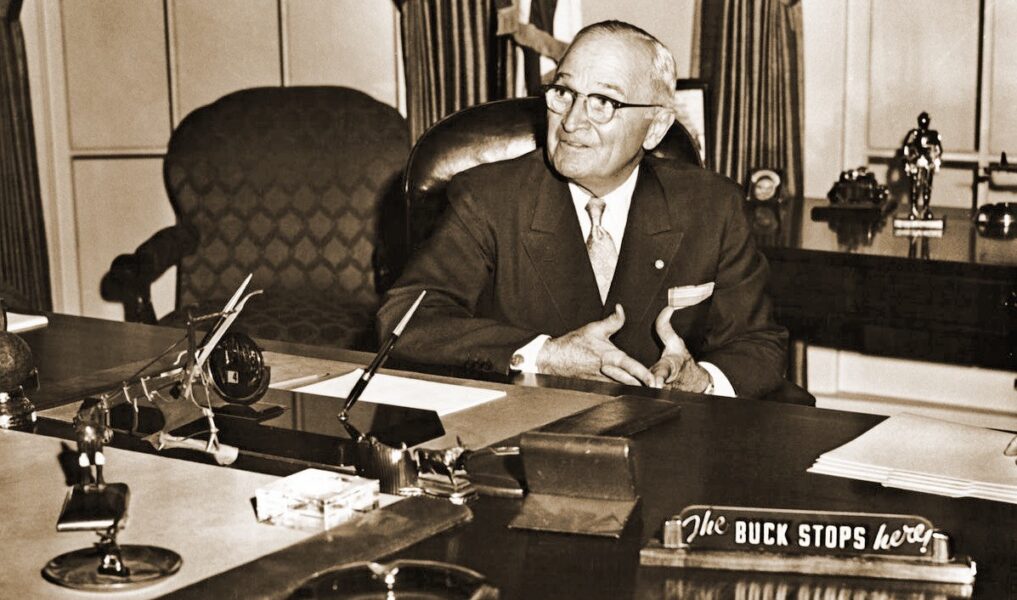
Take the example above. I have chosen to call this new regular column/blog/post – The Buck Stops Here. It is a phrase popularised by American President Harry S. Truman who kept a sign spelling it out on his desk in the Oval Office (see below). Of course, it means “I take full responsibility”, but how, exactly, did the word ‘buck’ get in there?
Its origins lie in poker. To help the players keep track of whose deal it was they used to put a marker in front of the dealer. Often in the American Frontier era this marker was a knife with a buckhorn handle or perhaps a piece of buckshot. If a player preferred not to deal, he (or she) would simply ‘pass the buck’ to the next player.
There, problem solved. I bet you feel a lot more enriched for knowing that!
It’s an idiom I (mis)use frequently, given my surname is Buckley. Indeed, I have thought about have a plaque made to put on my house in Pattaya with the phrase on it. There’s still time.
Idioms hold a fascination for me. I even went as far as buying a book of the subject (there are many) in the days when people were still reading books. Of course, when you need to refer to it, you can’t find it. It’s probably in my wife’s house in Pak Thong Chai, Korat (near the Jim Thompson farm). Fat lot of use it is to me there.
One of the books on the subject is cleverly titled, Kicking the Bucket at the Drop of a Hat. Kicking the bucket is, of course, another way of saying dying. Its origins are not totally clear, but a common theory is that someone wishing to commit suicide would tie a rope suspended from a beam around their neck while standing on a bucket and complete the self-destruction by kicking the bucket away to leave their body dangling. Cheerful thought, huh?
At the drop of a hat means to do something immediately. Again, it’s origins may be found in the American West where dropping a hat was used to signal the start of a fight (since replaced by ringing a bell).
If you stop to think for a moment about how many idioms you use in everyday conversation you might surprise yourself. I can think of several without missing a step.
For example, I have just seen a post from an old Dutch mate in Pattaya who owns the bar that was two doors away from the REm office (and very handy it was). It shows the rain tipping down as only it can in Thailand. English-speaking people might say ‘it’s raining cats and dogs’. But how did the domestic pets get in there?
If you Google this, you will see several explanations. The one I like best is that in olden times, homes had a thatched roof in which domestic animals such as cats and dogs would like to keep warm. In heavy rain, the animals would either be washed out, or abandon it seeking better shelter. It would be said to be raining cats and dogs.
Many oft-used idioms find their roots in naval expressions. Here are just a few examples:
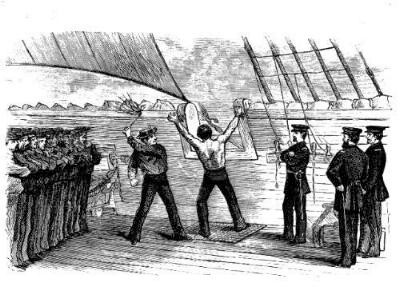
Cat got your tongue? The cat o’ nine tails was used to punish miscreant sailors. The pain inflicted made it difficult to speak – hence the cat had got your tongue. Also relates to the terms ‘letting the cat out of the bag’ i.e. you knew you were in trouble if the cat o’ nine tails was taken out of its bag and ‘swing a cat’ – being in a small room that’s not big enough to ‘swing a cat’ had nothing to do with grabbing your pet moggie by its tail and whirling it around.
Pull your finger out: Cannons had to be primed with gunpowder in the ignition hole. A sailor would keep it in place with his finger and had to ‘pull his finger out’ just before firing.
Freeze the balls off a brass monkey: A ‘monkey’ was a brass tray on which cannon balls were kept. In cold weather brass contracts, leading to the balls falling off.
True colours: False ‘colours’ or flags might be displayed when approaching an enemy ship to allow closer contact, but navy etiquette dictates that the correct flags (the White Ensign on a British warship, for example) are flown once battle commences, hence a ship then shows its true colours.
Three sheets to the wind: An expression indicating lack of control of a sail, or (in my case) being in a high state of inebriation.
Pipe down: At end of the day sailors would have to obey a whistle call from the bo’sun’s pipe, indicating that they stop talking, turn out lights and go to sleep.
I could quote many more. But, should I start to waffle, you might accuse me of ‘beating around the bush’ or taking you on a ‘wild goose chase’. Look them up!
I hope you will be back frequently to read this blog – not just ‘once in a blue moon’.

Dave Buckley is a career journalist. “I once went painting girders for a week and discovered I didn’t like heights,” he says. “Apart from that, it has always been journalism for me in one form or another.” Past publications worked for include the South-East London Mercury*, Kent Messenger, Daily Express, Today*, News of the World* and Hong Kong Star*. All those marked with an asterisk no longer exist (trend emerging?). He owned and edited a Thailand-based property magazine before returning to England and currently works as a production editor for an East Midlands-based publishing group.